


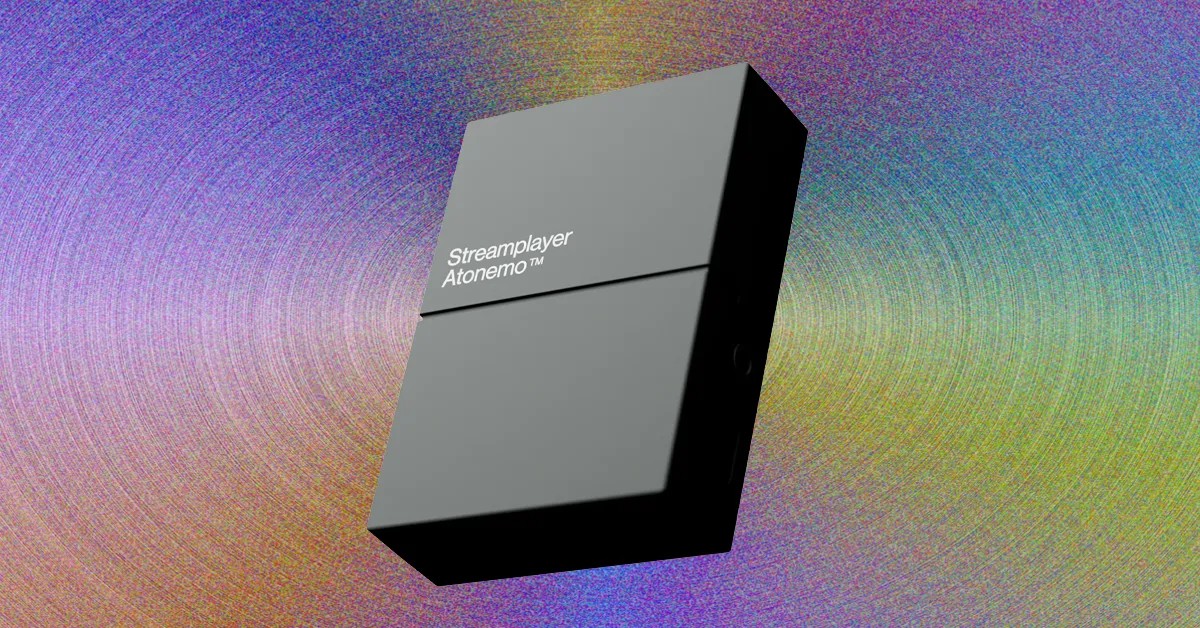
The consumer electronics industry thrives on planned obsolescence. New models appear every year, making older tech seem outdated even if it still works perfectly well. But what if you want to keep using your high-quality speakers and amps from the past while enjoying modern streaming services? Swedish startup Atonemo offers a solution with their compact Streamplayer, a device designed to bridge the gap between legacy audio and the convenience of platforms like Spotify and Tidal.
The Problem with Modern Audio
All-in-one smart speakers are convenient, but often sacrifice audio quality for ease of use. Millions of perfectly good analogue amplifiers and passive speakers sit unused, because they lack streaming capabilities. The Atonemo Streamplayer aims to solve this problem without forcing users to replace their existing equipment.
A Minimalist Approach
The Streamplayer is remarkably simple: a matchbox-sized device (1.97 x 2.76 x 0.73 inches) with AirPlay 2, Chromecast, Spotify Connect, and Tidal Connect support. It outputs audio via a single 3.5mm jack (analogue or optical S/PDIF) and is powered by USB-C. The Atonemo app handles setup and Wi-Fi connection. The focus is on function over form; there’s no display, just a single button.
The device connects quickly: the author tested it with a vintage Vita Audio R1 Mk1, turning it into a streaming device within three minutes. The app is streamlined and responsive, unlike some competitors.
Sound Quality: Convenience vs. Fidelity
While convenience drives the “smart” audio market, Atonemo acknowledges that sound quality matters. The Streamplayer uses a Realtek SoC integrated DAC, capable of 24-bit/192 kHz resolution. This is a compromise: it’s not on par with high-end standalone DAC chips (ESS, Cirrus Logic, AKM), but acceptable for a $99 device.
In testing, the Streamplayer performed well with older equipment. When plugged into a 20-year-old Arcam amplifier powering Mordaunt Short floorstanding speakers, it delivered smooth streaming from Qobuz and Spotify Lossless. However, side-by-side comparisons with a Cambridge Audio CD player revealed a noticeable difference: CD provided more power, scale, and detail. Streaming, while convenient, couldn’t match the fidelity of physical media.
Connectivity Concerns
The Streamplayer includes only a single 3.5mm-to-3.5mm audio jack. While this covers many active speakers and aux-in ports, passive speakers require an amplifier and additional cables (3.5mm to RCA, or S/PDIF to RCA). Atonemo considered including multiple cables but opted for simplicity, betting that most hi-fi enthusiasts already have what they need. The company plans to sell cable bundles separately, but this adds friction for first-time users.
Competition and Alternatives
Atonemo faces competition from the WiiM Mini Music Streamer ($89) and the FiiO SR11 Desktop Streaming Music Receiver ($110), both of which offer similar functionality at similar prices. The Bluesound Node nano streamer ($379) provides higher audio quality and multi-room capabilities, but at a steeper cost. Basic Bluetooth dongles are even cheaper, but lack the features of dedicated streaming devices.
Atonemo’s strength lies in its simplicity. The app is stripped-down and user-friendly, avoiding the bloatware found in some competitors. It doesn’t try to be everything to everyone, instead focusing on one task: enabling streaming on legacy equipment.
Conclusion
The Atonemo Streamplayer won’t transform your old speakers into audiophile-grade miracles. But for $99, it offers a convenient and effective way to breathe new life into existing audio setups. If you value simplicity over absolute fidelity, and want to keep your classic hi-fi gear relevant, this device is worth considering.


