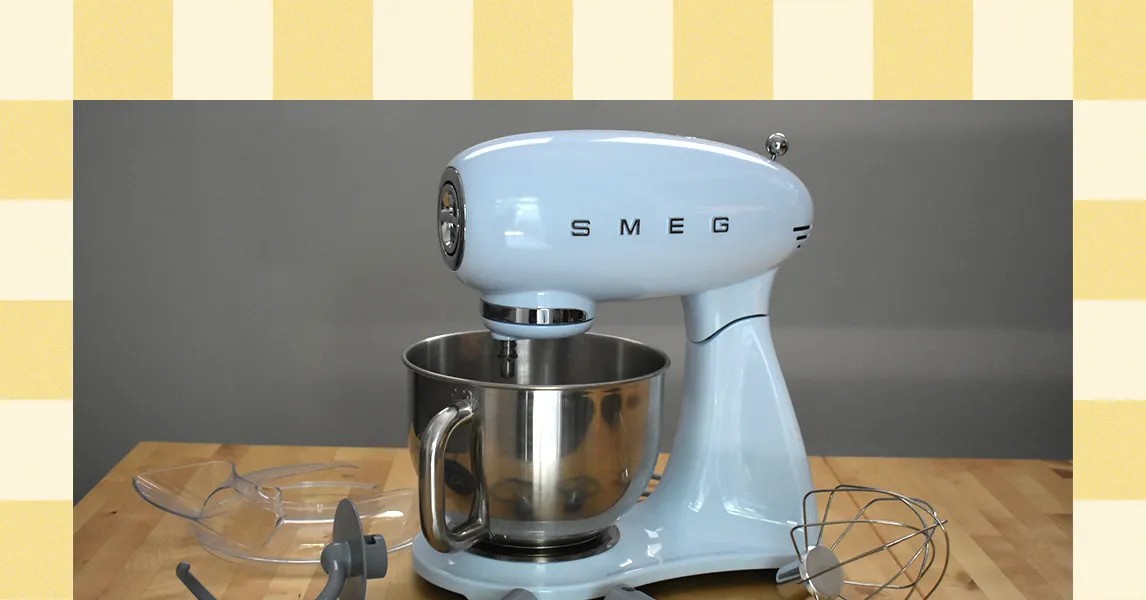
The stand mixer market is undergoing a significant refresh. While KitchenAid recently upgraded its popular Plus model with LED lighting and refined speed controls, Smeg has entered the fray with a bold new contender: the Smeg Forte. Launched in April alongside the Classico, the Forte aims to blend 1950s retro aesthetics with modern power, specifically targeting home bakers who demand performance without sacrificing style.
For enthusiasts, the headline feature is undeniable: a 750-watt motor. To put that in perspective, the widely used KitchenAid Artisan operates on just 325 watts. This power disparity promises the ability to churn through dense doughs and heavy batters with ease. But does raw power translate to superior baking results, or does it introduce new mechanical challenges?
Power Meets Physics: The Stability Trade-off
The core promise of the Smeg Forte is its Direct Drive motor, designed to prevent burnout even under heavy strain. It features 10 speed settings and a “smooth-start” function intended to ramp up momentum gradually rather than jerking into high gear. In practice, however, this start-up feels more like a half-speed jump than a seamless acceleration.
The most significant revelation during testing was not the motor’s power, but its impact on the machine’s stability.
Key Insight: The 750-watt motor may be overkill for the mixer’s 5-quart capacity and body structure.
While the tilt-head mechanism is designed to mimic the motion of hand-kneading by bouncing slightly, the mixing bowl itself jigged noticeably, even at lower speeds. This movement persisted despite ensuring the bowl was locked and the head was engaged. This instability is unusual for high-end stand mixers and suggests a mismatch between the engine’s force and the chassis’s ability to absorb it. For comparison, other heavy-duty models with similar wattage often feature larger capacities (such as 7+ quarts) to better distribute the mechanical stress.
Design and Usability: Form Over Function?
Smeg has prioritized aesthetics, resulting in a machine that is undeniably striking. The Forte is available in up to seven colors and features a die-cast aluminum body weighing approximately 28 pounds —about 2–3 pounds heavier than standard KitchenAid Artisan models. Anti-slip feet help anchor it, but the weight alone doesn’t fully counteract the vibration from the powerful motor.
Control Mechanisms:
* Speed Knob: Located on top of the mixer rather than the side. While visually appealing, this placement offers little practical advantage over traditional side knobs.
* Tilt-Head: Operated via a button at the back of the head, which also engages a safety lock. This is a departure from the lever-style latch found on competitors, offering a cleaner look but requiring a different muscle memory.
Attachments: A Mixed Bag
The Forte utilizes a planetary mixing system with a spring-load attachment hub. It comes with several tools, including a wire whisk, flat beater, pour shield, and two newer additions: a flex-edge beater and a dough hook.
- Flex-Edge Beater: The standout performer. The silicone edge effectively scrapes down the sides of the bowl, ensuring eggs, butter, and sugar are fully incorporated without manual intervention. It quickly became the preferred tool for batters.
- Dough Hook: With a wider profile than typical hooks, it performed efficiently, folding doughs quickly and effectively at lower speeds.
- Wire Whisk & Flat Beater: These performed adequately but lacked the precision of premium competitors. The wire whisk, in particular, struggled to incorporate dry ingredients as meticulously as expected.
- Pour Shield: Functional and secure, but not innovative.
Maintenance and Durability Concerns
Cleaning is generally straightforward, as most attachments and the stainless steel bowl are dishwasher-safe (except for the wire whisk, which requires hand-washing). However, two design choices raise long-term durability questions:
- Plastic Exterior: The outer shell is plastic, which is easy to wipe down but prone to scratching and damage. Given the $675 price tag, users may expect more robust materials that better withstand kitchen wear and tear.
- Attachment Hub: The chrome cover on the side hides the attachment hub, but it is not watertight. Unlike KitchenAid’s metal screw-on caps, Smeg’s plastic cover feels flimsy. While easier to remove for cleaning, it poses a risk for liquid seepage into the internal mechanisms if not dried thoroughly after washing.
The Verdict: Beauty vs. Utility
The Smeg Forte is a polarizing appliance. It is visually stunning and undeniably powerful, but it falls short in key areas of performance and build quality compared to its main competitor, the KitchenAid Artisan Plus.
Who is this for?
* Not the best choice for: Serious bakers, frequent users, or those seeking precision and stability. The bowl movement can be jarring, and the attachments are merely “good enough” rather than exceptional.
* A solid choice for: Casual bakers who prioritize kitchen aesthetics. If you value the retro look and plan to use the mixer occasionally for simple tasks, the Forte delivers a stylish presence that can serve as a conversation piece.
Bottom Line:
When considering value, the KitchenAid Artisan Plus often sells for up to $175 less while offering more speeds, a bowl light, and dishwasher-safe attachments with greater stability. For the majority of home cooks, the Smeg Forte’s premium price is hard to justify when a more reliable, feature-rich alternative exists at a lower cost. However, for those whose kitchen design takes precedence over heavy-duty utility, the Forte remains a beautiful, if imperfect, option.