
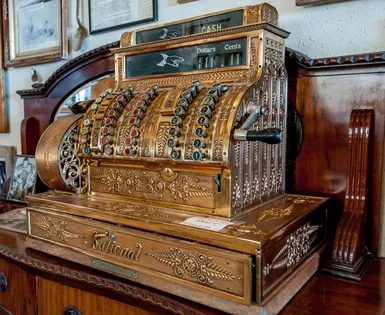
James and John Ritty get the credit for inventing the cash register. That is a technical fact. But John H. Patterson? He made it matter. He turned a clunky invention into an essential piece of retail infrastructure. Without him, the NCR brand might have remained a footnote in Ohio history. Today, the legacy lives on in NCR Voyix Corporation, a major player in digital banking and point-of-service software.
The Dayton Struggle and the Patterson Pivot
The Ritty brothers patented their device in 1879. They needed to sell it. So they founded the National Cash Register Company. It was soon renamed the National Manufacturing Company. The location was unfortunate. They operated out of a run-down section of Dayton, Ohio. Sales were weak. The technology was solid, but the business model was not.
Enter John H. Patterson in 1884.
He bought a majority share. He secured the patent rights. He did not just market the product. He revolutionized how it was sold. Patterson simplified the machine. He made it easier for clerks to use. He sent out a sales force that was highly motivated. The strategy was aggressive. He introduced exclusive territories for each salesman. It was a novel concept at the time.
He also solved the biggest fear of retail owners: maintenance. Complex machinery breaks. Customers worried about repair costs. Patterson established a dedicated force of repairmen. They serviced the products after the sale. This built trust. It also allowed him to acquire competitors. He targeted smaller, regional cash register manufacturers. He swallowed them up.
Monopoly, Antitrust, and Public Markets
By the early 20th century, NCR dominated the market. It held about 95% of the U.S. cash register market. Monopolies tend to attract regulators. Antitrust laws are not subtle.
In 1912, the outcome was inevitable. NCR and over two dozen executives, including Patterson, were found guilty of violating the Sherman Antitrust Act. The legal battle lasted three years. The convictions were overturned in 1915. Patterson died in 1922, never seeing the next major shift.
Four years later, the company went public. The stakes were high. The initial public offering (IPO) raised $55 million in stock. At that time, it was the largest IPO in U.S. history. The market took notice.
Evolution from Hardware to Financial Services
NCR did not stay static. The 20th century brought constant adaptation. The company added accounting machines in the 1920s. Electronic products emerged during World War II. By the 1960s, they were producing business forms, computer hardware, and software. The 1970s brought microelectronics.
Leadership during the latter decade included William S. Anderson and Charles E. Exley, Jr. They continued to develop new technology. They expanded into new markets. But growth came with pain. The company underwent a thorough reorganization. There was a sharp reduction in its labor force. Operations decentralized. They moved away from their Dayton roots.
AT&T purchased the company in 1991. It was renamed Global Information Solutions. But mergers can be messy. AT&T split into three companies in 1996. NCR was spun off to AT&T shareholders. It regained its original name. The focus narrowed. The company concentrated on financial technology. Specifically, ATMs. Mobile banking. Retail software.
The Modern Split
History repeats in corporate structures. In 2023, NCR Corporation split again. The result was two distinct entities. NCR Voyix Corporation focuses on e-commerce, digital banking, and point-of-service retail and restaurant software. Its sister company, NCR Atleos, oversees automated teller machine (ATM) operations. Both are headquartered in Atlanta.
The cash register is no longer just a box that opens. It is a node in a vast digital network. The founders in Dayton could not have imagined the scale. Patterson understood one thing clearly. Technology needs to be managed. Sales need to be aggressive. Maintenance needs to be guaranteed. Those principles still drive the business today.
The market is shifting again. Digital payments are replacing physical currency. Mobile wallets are growing. Where does the cash register fit in a world without cash? The hardware is evolving. The software is becoming the product. The split into Voyix and Atleos suggests a bifurcation. One arm handles the retail interface. The other handles the cash access.
It is a strange evolution. From a machine to prevent theft to a platform for global finance. The core idea remains the same. Trust in the transaction. Without that trust, retail stops. Patterson built the trust. Voyix is trying to maintain it in a digital world. The tools have changed. The pressure has not.
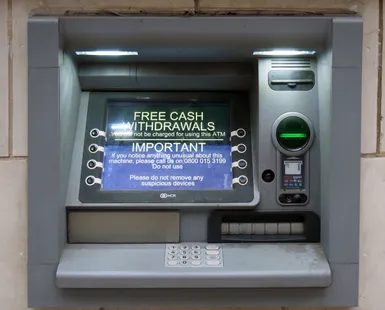
The logic behind corporate splits rarely makes for a gripping drama. It is usually dry, bureaucratic, and driven by spreadsheets. But the separation of NCR Corporation tells a different story. It was about carving away parts of a business that simply stopped fitting together.
NCR didn’t just divide itself because it wanted to. It aimed to keep its ATM division entirely separate from its software as a service (SaaS) and self-checkout technology divisions. The vision was clear. You cannot run a legacy ATM hardware business with the same growth metrics as a modern SaaS platform. They require different capital structures, different sales cycles, and different investor appetites.
The Anatomy of the Split
In 2022, NCR laid out the plan. It was not a liquidation. It was a bifurcation.
Two new entities emerged from the shell of the old corporation.
NCR Voyix took the front of the store. This entity focuses on digital commerce. Think point-of-sale transaction technology. Think self-checkout machines. It is the visible face of retail interaction, the hardware and software that sits on the counter.
NCR Atleos took the back office. It was created specifically to handle and outsource the company’s surcharge-free ATMs. This is the infrastructure play. It is about connectivity, maintenance, and the quiet, unglamorous work of keeping cash flowing in bank lobbies and grocery aisles.
The goal was not to shrink. It was to clarify. Each company could now be valued by what it actually does, rather than being dragged down by the other’s struggles.
Execution and Aftermath
The plan moved from paper to reality in October 2023.
NCR completed its planned division. The two entities began operating independently. They also began trading separately on the New York Stock Exchange (NYSE). This was the final step. Investors could now choose their exposure. Buy Voyix if you believe in retail’s digital future. Buy Atleos if you believe in the resilience of physical cash infrastructure.
The split was not the end of the story. It was a prologue.
The Veritas Deal
The following year, NCR Voyix proved that being a standalone public company changed its strategic options. It sold its digital banking unit.
The buyer was Veritas Capital.
The deal was valued at $2.45 billion.
This move highlighted a key trade-off in modern corporate strategy. NCR Voyix shed assets that were not core to its point-of-sale focus. It raised capital. It simplified its portfolio. The digital banking unit was a good asset, but perhaps not the right fit for a company now defined by self-checkout and retail software.
Why This Matters for Investors
The NCR split offers a case study in corporate restructuring. It shows how companies can use separation to unlock value that was previously hidden.
For investors, the lesson is straightforward.
- Complexity is expensive. When a company does too many things, its valuation becomes a mystery.
- Clarity pays. By splitting, NCR allowed the market to price each business on its own merits.
- Strategic agility increases. Selling the digital banking unit for $2.45 billion would have been harder to justify within