
Ignore the live coding demos. Skip the AI bootcamps. Ignore the obstacle course for gadgets and the people wandering around in silent-disco headphones, beaming UN panel audio directly into their ears. Breathe. Then find yourself sitting on UFOTECH, a rotating network bench that looks less like corporate furniture and more like a lazy Susan at a Chinese banquet.
This is the “AI for Good” summit. Hosted by the UN’s International Telecommunication Unit. The goal is noble: harness tech for humanity, not its detriment.
Silicon Valley execs are in Washington, testifying to lawmakers about the terror of superintelligence. The White House is slapping export controls on chips. Meanwhile, this is year 10 of the UN summit, focused on idealism.
“Our conviction that artificial intelligence, deployed responsibly could help solve humanity’s most pressing problems,” says Doreen Bogdan Martin, secretary-general of the ITU. Hunger. Disease. Climate change.
Is that the case? Or is it just words? The convention center sprawls across 106,00 square meters on the edge of Geneva. It hums with anxiety. A drumbeat of worry. People fear that unchecked corporate monopolies are hardwiring global inequality, eroding rights, all in the name of “efficiency.”
Some folks on the ground are done with the utopian veneer.
Giulio Coppi from Access Now calls it what it is.
“We should be out of the age of innocent.” He tells the public and humanitarian sectors to stop treating big tech “as your best friends.” He cites a decade of opaque multimillion dollar deals, funded by taxpayer money. “You can’t even explain what’s inside your tech stack. Because it keeps changing.”
His tone was muted compared to the storm that erupted during Amazon CTO Werner Vogels’ keynote. Pro-Palestine activists rushed the stage, alleging Amazon tech is used against Palestinians in Israel. They were eventually bundled out.
“The hype is nice. We get excited about it. The damn thing never lands in practice,” says Vijay Janapa Redd, a Harvard engineering professor, shouting over the noise. He argues “good” is a useless standard for engineers. You can’t build something that is vaguely good. A plane that only flies for five minutes isn’t “good.”
Who gets to play? That’s the real fight now. Who accesses the models? Who buys the chips? The Trump administration flips export controls on and off like a switch. China considers tightening its grip on open-weight models. Tighten the screws and poorer countries get locked out. They end up dependent on foreign infrastructure, foreign standards.
It’s a development problem. Not just a tech problem.
“If we mean AI for good meaning compute for all. We must recognize this is development infrastructure. Not just technology.” Syed Munir Khawr. The Chairman of the Institute for policy. Advocacy and governance.
Most large language models still speak English. Smaller, local LLMs on cheap hardware are the only hope for communities outside the richest markets. The politics of infrastructure are constant here. The question isn’t just safety. It is whether the world outside the U.S.-China-Europe axis gets to shape this thing at all.
Traditionally engineers may consider human rights as someone else’s business. Actually, they are not. Gilles Thonet, deputy-secretary-general.
The decisions matter. Not in these UN halls, but in the hidden architecture. The technical standards. The procurement choices.
Anja Kasparsen from the IEEE wants middleware. A connective layer to translate human rights into technical code. Real enforcement. Not just vibes.
Jeremy Ng from the world Bank adds impact assessments need teeth. They need to stop being governance theater for tech giants. A box ticking exercise.
Talk. Plenty of talk. Less action.
That is the point, they say. Summits require consensus. The UN touted a 44-member Commission on AI for Good. Cofunded by Rwandan president Paul kagamie and Salesforce CEO marc benioff.
“No single stakeholder can shape the Future of AI alone. It needs builders. It need you.” says Bogdan.
On the bustling floor though.
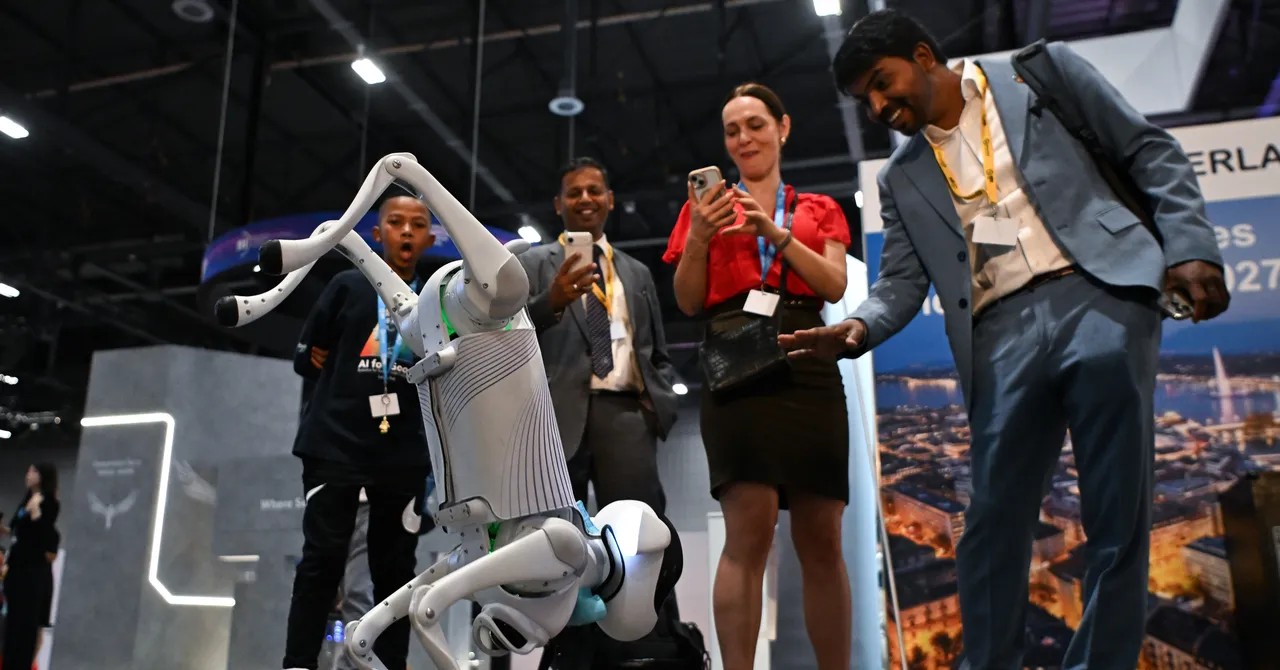
Tesla Cybertrucks sit next to UN rescue helicopters. A few humanoid robots zip between the booths. The attendees stare.
The robots are moving fast. Really fast.
It’s not hard to guess where this is heading. The tech is sprinting away. Leaving the definition of “good” in the dust.