
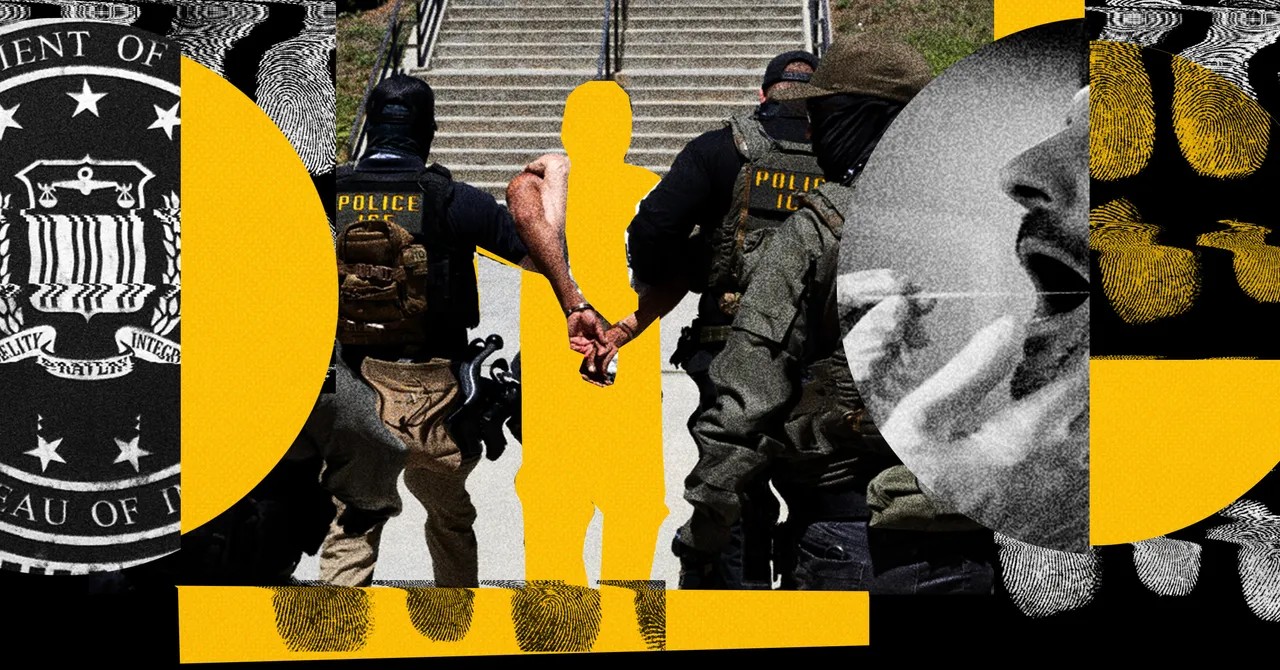
Hugo Moreno-Mendez thought he was walking into a standard probation check-in at the McLennan County Probational Department in Waco, Texas. It was March 13, 2005. Instead, Immigration and Customs Enforcement agents were waiting.
They drove him to an ICE field office. One after another, deportation officers approached him with a single, escalating demand.
Open your mouth.
First came the request for fingerprints and a cheek swab. He refused. Another officer tried. Then a third. He refused each time.
Four days later, he faced charges. Failing to register as a noncitizen? Yes. Refusing to provide DNA while in federal custody? Also yes. The latter is a misdemeanor, though ICE admitted in 2021 that it didn’t even know such cases had been accepted for prosecution. Moreno-Mendez went to trial. On August 18 of that year, a magistrate judge found him guilty of both. He got time served.
Moreno-Mendez was just one person. But his case illuminates a massive, systemic shift. The federal government is now collecting DNA from nearly everyone in ICE custody. The result? A sweeping expansion that funnels the genetic profiles of civil immigration detainees into the FBI’s Combined DNA Index System (CODIS)—a database designed for criminal investigations, not administrative processing.
How big is this shift? Georgetown Law’s Center on Privacy and Technology recently estimated that in 2025 alone, ICE added roughly 920,000 DNA profiles to the national system. That’s not a typo. That’s nearly one million people.
From Border Patrol to ICE: Who is Getting Swabbed?
For years, the story of government DNA collection ended at the border. Customs and Border Protection (CBP) handled the bulk of it. According to internal ICE training slides obtained via Freedom of Information Act requests, ICE was barely a blip. In fiscal year 2020, ICE collected 3,609 samples. By mid-May of fiscal 2021, they had added another 16,392. Total: around 20,000.
Meanwhile, CBP was moving at industrial scale. Spreadsheets obtained by Georgetown show CBP sent DNA from at least 1.36 million individuals to the FBI between October 2020 and late 2024.
Then, in 2025, the dynamic flipped.
FBI records show the “detainee” index within CODIS grew by roughly 995,023 profiles in a single year. That averages out to more than 2,737 people every day for 365 days. CBP accounted for only about 75,215 of those submissions. ICE, refusing to release its own data, is estimated to be responsible for the vast majority of the remainder.
Why the change? ICE now handles roughly 85 percent of immigration detentions, up from when CBP held the majority. As of mid-2025, ICE was holding over 65,000 people at any given time, with arrests climbing toward 1,500 daily. Most have no criminal history.
“None of the families at Dilley have convicted of a crime. They do not belong in a database meant for criminals, especially children.”
— Representatives Joaquin Castro, Greg Stanton, Nanette Barragán
The “Fun Facts” Slide
This expansion didn’t happen by accident. It required a regulatory overhaul. In 2005, Congress allowed DNA collection from federal arrestees. But for years, DOJ regulations gave DHS wide latitude to exempt immigration detainees if processing them was too resource-intensive.
In 2020, DOJ killed the exemption. ICE issued Directive 1002.1 in December of that year. The mandate was clear: collect DNA from nearly everyone.
Internal training materials obtained by Georgetown reveal just how aggressively officers were told to enforce this. One May 2021 slide instructed Enforcement and Removal Operations (ERO) agents that asylum seekers and refugees were not exempt. Therefore, their DNA must be sampled. Another slide, in bold capital letters, told officers to ensure collection happened after ANY arrest.
Then came the section labeled “FUN FACTS.”
A presentation listed 69 confirmed hits in CODIS from samples submitted in a mere six-month window. These matches included evidence from sexual offenses, homicides, missing persons cases, burglaries, and even a stolen Pinto. The author added a casual note at the bottom: “Editor’s note: you’d care if that was YOUR Pinto!”
Got a Tip?Are you a current government employee? Contact the reporter on Signal.
Is This For Identification or Crime-Solving?
The legal defense for this program hinges on the idea of “identification.” After the 2005 Maryland v. King Supreme Court ruling, warrantless DNA collection from arrestees was upheld because it helped verify identity.
Georgetown argues this logic collapses when applied to civil immigration cases. These aren’t serious felonies where identity verification prevents flight. And these samples don’t stay in an administrative file. They go into CODIS. They can be matched against crime scenes from decades in the past—or future crimes that haven’t been committed yet.
The government’s own lawyers might know this. In March 2025, an ICE attorney provided a legal opinion stating the primary purpose of DNA collection is to build a national database for solving crimes—not for verifying family relationships or basic ID.
Stevie Glaberson, a co-author of the Georgetown report, says this email destroys the government’s public justification. “The Fourth Amendment prohibits compelling you to hand over sensitive genetic info on speculation it might help solve crimes in the future,” Glaberson noted. “This email proves that’s exactly what the program does.”
DHS declined to comment on whether it agreed with its own lawyer’s assessment.
Prosecuting the Right to Refuse
ICE training materials warn detainees that refusal is a federal crime. They refer refusal cases to prosecutors. For a long time, it was all talk. In 2021, training slides admitted the agency hadn’t prosecuted a single refusal case.
Now, it’s happening.
Alongside Moreno-Mendez, the Justice Department filed charges against Ronald Genao-Diaz. In Puerto Rico, CBP agents asked him for a swab at least five times. He refused, covering his mouth with a mask. He was charged under the same statute as Moreno-Mendez and with document fraud. He pleaded guilty in May 2025. Time served. A fine.
The message is clear: If you are in custody, you are in the database. Resistance has a cost.
Children in the System
The most disturbing aspect of this expansion involves families and minors. In May 2026, during an inspection of the Dilley Immigration Processing Center, lawmakers learned ICE had been collecting DNA from detained children for three months.
Conflicting explanations followed. DHS later told WIRED that ICE may collect samples from children as young as 13. But the records tell a different story. Georgetown and WIRED analyzed CBP data identifying 492 children under 14 whose DNA was sent to the FBI between January 2 on 2025 and 2026. That includes 33 seven-year-olds. Thirty-two six-year-olds. Twenty-one five-year-olds.
There is even a record of a four-year-old Mexican child processed in El Paso in January 2026 before being returned to Mexico.
Leecia Welch, counsel for Children’s Rights, has visited Dilley a dozen times since it reopened. Families report being swabbed without explanation.
“People are very confused about why their child is being tested,” Welch said. “They aren’t being told what this is for. It creates a lot of stress.”
Sworn declarations reveal a chaotic mix of procedures. In 2026, a mother said Border Patrol took swabs from her and her five-year-old son but told them nothing. Another claimed they were fingerprinted and given “DNA tests.” A twelve-year-old was told it was for “security reasons” and paternal verification—a claim that sounds more like family unity processing than criminal database entry.
Federal agencies haven’t even been consistent about their own age limits. Families often never learn the results of these tests. They just know their genetic data is sitting in a federal lab, indefinitely, accessible to law enforcement everywhere.
The Future of the Database
This isn’t a temporary spike. It’s a new normal.
Before 2020, profiles from federal detention were a negligible sliver of CODIS. By 2024, they made up about 9 percent. If current rates hold, Georgetown projects that by 2030, the Department of Homeland Security will supply more than a third of the entire CODIS index. A milestone previously projected for 2034 will arrive four years early.
The physical samples—the entire genome, the biological blueprint of millions of civil immigrants—are sitting in federal laboratories. Indefinitely.
No trial. No criminal conviction. Just a swab, a refusal, and a life added to a national search engine.